
It’s 2:30 on a Thursday. Your QC tech has a stack of 125 compression springs to check before the truck shows up at 4:00. Each one gets loaded onto the platen, compressed to test height, read off the display, and written on a clipboard. Somewhere around spring 80, the readings start drifting a little high. Is it the springs, the operator, or the fact that it’s been two hours of the same motion?
Nobody knows. And that’s the problem.
Manual spring testers have earned their place on the shop floor. They’re simple, reliable, and cheap to run. But there’s a point in almost every spring shop’s growth where manual testing stops being the safe, economical choice and quietly becomes the bottleneck, or worse, the weak link in your quality system. This article walks through how to recognize that point, what automation actually buys you, and how to make the switch without disrupting the line.
What Manual Testing Does Well
Before talking about automation, it’s worth being honest: a manual tester is the right tool for a lot of work, and plenty of shops will never outgrow one.
Manual testing shines when volume is low and variety is high. Prototype runs, first-article checks, engineering samples, and short-run job shop work all fit here. When you’re testing 10 pieces of 40 different part numbers, the setup time on an automated system can eat any speed advantage it offers.
It’s also flexible. An experienced tech can adapt on the fly, test an odd geometry with a makeshift fixture, or spot a visual defect while the spring is in hand. That human judgment has real value, especially during development.
And the economics are straightforward. Lower purchase price, minimal training, almost no software to maintain. For a shop testing a few hundred springs a week to loose tolerances, a well-calibrated manual tester is often the smartest money you’ll spend.
Where Manual Testing Breaks Down
The limits of manual testing rarely show up all at once. They creep in as volume, tolerances, and customer expectations rise.
Operator variability
On a manual tester, the operator controls approach speed, how long they dwell at test height, and when they read the number. Two techs testing the same spring can get different results, and the same tech can drift over a long shift. If you’ve ever run a gauge R&R study on a manual tester and been disappointed, this is usually why. When your tolerance band is tight, operator-induced variation can consume a meaningful share of it before the spring even gets a vote.
Throughput
A skilled tech might manage a few springs per minute on a simple single-point check. Add a second test height, a free length measurement, or a rate calculation, and that number drops fast. When order volume doubles, your options are more people, more overtime, or smaller sample sizes. None of those are good.
Sample size pressure
This is the quiet one. When testing is slow, sample sizes shrink to fit the schedule rather than the risk. Checking 5 springs out of a 20,000-piece lot because that’s all there’s time for is a statistical bet, not a quality plan.
Data capture
Clipboards and hand-keyed spreadsheets introduce transcription errors and make the data hard to use. You can’t easily run SPC, spot a trend across shifts, or hand a customer a clean report when the numbers live in three binders and somebody’s desktop.
What “Automated” Actually Means
Automation isn’t a single jump from a hand crank to a robot. It’s a spectrum, and most shops get the biggest return from the first step or two.
| Level | What changes | Best fit |
|---|---|---|
| Manual | Operator drives the crosshead and reads the result | Low volume, prototypes, loose tolerances |
| Motorized with software | Controlled speed and test heights, automatic pass/fail, data saved digitally | Most production QC; the biggest jump in repeatability |
| Semi-automatic | Programmed multi-point routines, auto rate calculation, SPC built in | Tight tolerances, PPAP and customer reporting |
| Fully automatic | Parts fed, tested, and sorted without an operator | High-volume runs, 100% inspection requirements |
The move from manual to motorized with software is where most of the repeatability gain lives. The machine approaches at the same speed, stops at the same height, and records the same way every time. Operator variability largely disappears from the measurement, and the data lands in a file instead of on a clipboard.
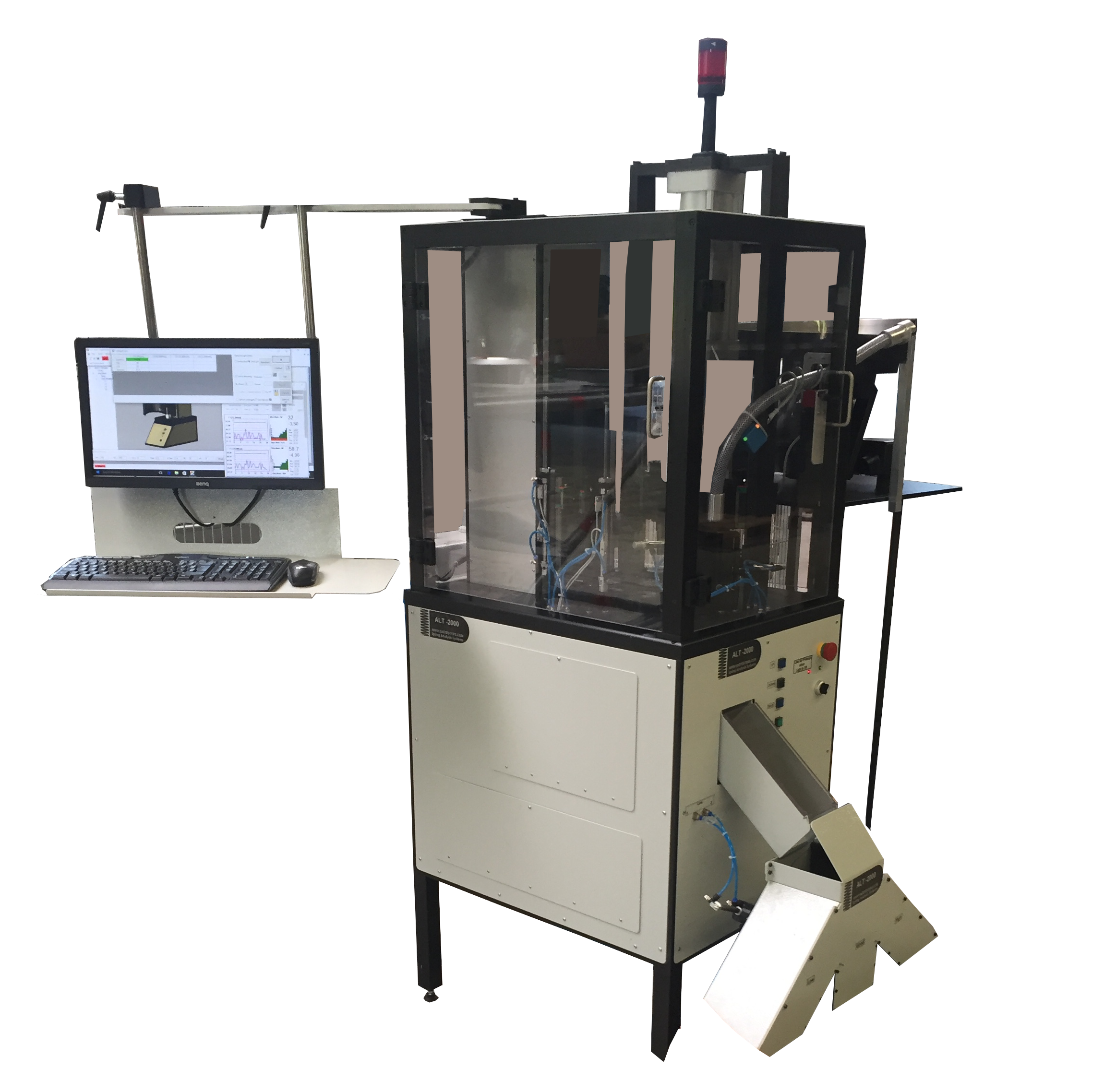
Fully automatic systems with feeding and sorting make sense when you need 100% inspection or are running millions of pieces a year. Dedicated load-test-and-sort machines are built for that volume, with some rated above 4,000 parts per hour. The SAS ALT series, for example, combines setting, load testing, and multi-way sorting on a single turntable, with real-time SPC built in. They’re a bigger investment and a bigger integration project, so they should be justified by volume, not by enthusiasm.
Five Signals It’s Time to Switch
If two or more of these sound familiar, it’s worth running the numbers on automation.
- Testing is setting the shipping schedule. When finished springs sit waiting for QC, or you’re trimming sample sizes to make the truck, testing has become a constraint on revenue.
- Your tolerances got tighter. A customer moved from ±10% to ±5% on load, and your gauge R&R no longer leaves enough room. Removing operator influence is often the cheapest way to win that margin back.
- Customers want data, not a checkmark. Automotive, medical, and aerospace customers increasingly expect PPAP documentation, Cpk values, and traceable test records tied to a lot number. Producing that by hand is slow and error-prone.
- You’ve had a disagreement you couldn’t settle. If a customer’s incoming inspection rejected parts and you had no clean data to show what you measured and how, consistent automated records would have changed that conversation.
- Your best tester is your only tester. If quality depends on one experienced operator’s technique, you have a staffing risk dressed up as a quality process. Programmed routines let a newer tech produce the same result.
Running the Numbers
The automation case usually rests on two numbers: what each test costs in labor, and what a quality escape costs when one gets through.
Labor per test
Start with the labor rate. The U.S. Bureau of Labor Statistics puts the median wage for quality control inspectors at $22.82 an hour. That’s not what an inspector actually costs you, though. For production workers in manufacturing, wages are only about 65% of total employer compensation; benefits make up the rest. Load the median wage accordingly and you land at roughly $35 an hour.
The test times below are typical estimates for a 3-point compression check. Swap in your own.
| Manual | Motorized with software | |
|---|---|---|
| Time per spring (3-point test) | 60 seconds | 20 seconds |
| Springs tested per week | 2,000 | 2,000 |
| Operator hours per week | 33.3 | 11.1 |
| Labor cost per week at $35/hr loaded | $1,167 | $389 |
That’s roughly $780 a week, or about $40,000 a year, in recovered labor on a modest volume. Those hours don’t disappear; they get redeployed to work that actually needs a person.
Cost of an escape
The labor math is the easy part. The bigger number is often the one you don’t see until it happens. A single rejected lot can mean sorting labor at the customer’s site, expedited replacement freight, a chargeback, and a corrective action report. Add the hit to your supplier scorecard, and one escape can cost more than the tester. Across manufacturing, the cost of poor quality averages around 15% of sales and ranges from 5% to 35% depending on product complexity, according to the Institute of Industrial and Systems Engineers. Warranty claims alone averaged 1.30% of product sales for U.S. manufacturers in 2025.
Automation doesn’t make escapes impossible. It makes them less likely by tightening repeatability and allowing larger sample sizes, and it gives you clean data to diagnose the cause when one does happen.
Making the Transition Without Disrupting the Line
The switch itself is where good intentions go sideways. A few practical steps keep it smooth.
Run both systems in parallel first
Don’t retire the manual tester on day one. Test the same set of springs on both machines for a few weeks and compare. You’ll likely see the automated readings come in tighter, and possibly offset slightly from your historical numbers. That offset is useful information, not a problem. It usually traces back to approach speed or how the operator was reading height.
Do a correlation study with key customers
If your numbers shift, your customers should hear it from you first. Share the parallel data, explain the source of any difference, and agree on a reference method. A short correlation exercise now prevents a long dispute later.
Get fixtures right
Platens, guide pins, and hook fixtures matter as much on an automated machine as on a manual one. Budget for proper tooling for your highest-volume part families, not just the tester itself.
Program the routines once, centrally
Build the test programs for each part number as a controlled document. That’s what turns automation into a consistent process instead of a faster version of everyone’s personal method.
Train for interpretation, not just operation
The machine handles the measurement. Your team still needs to understand what a rising rate trend or a widening spread means and what to do about it.
The Bottom Line
Manual testing isn’t wrong. It’s a tool with a range, and most growing spring shops eventually work past the edge of it. The signals are usually obvious in hindsight: testing gating shipments, tolerances outpacing repeatability, and customers asking for data you can’t easily produce.
If you’re seeing those signals, RK Trading can help you figure out where on the automation spectrum your shop belongs. As the North American distributor for SAS spring testers, we work with spring makers to match the tester to the actual workload, not the biggest machine on the spec sheet. Talk to RK about your testing needs, and we’ll help you run the numbers for your shop.