
Most engineers work with springs at some point in their career. But springs aren’t one-size-fits-all components. The spring you use in a suspension system, a shock absorber, or a valve assembly behaves completely differently from the spring in a door hinge or a mechanical latch. Understanding these differences—not just how they function, but how they’re manufactured, fail, and need to be tested—is essential for selecting the right spring and ensuring reliable product performance.
The two most common spring types are compression springs and extension springs. While they might look superficially similar, their design, mechanics, and failure modes differ significantly. More importantly, they require different testing approaches.
Compression Springs: Design and Function
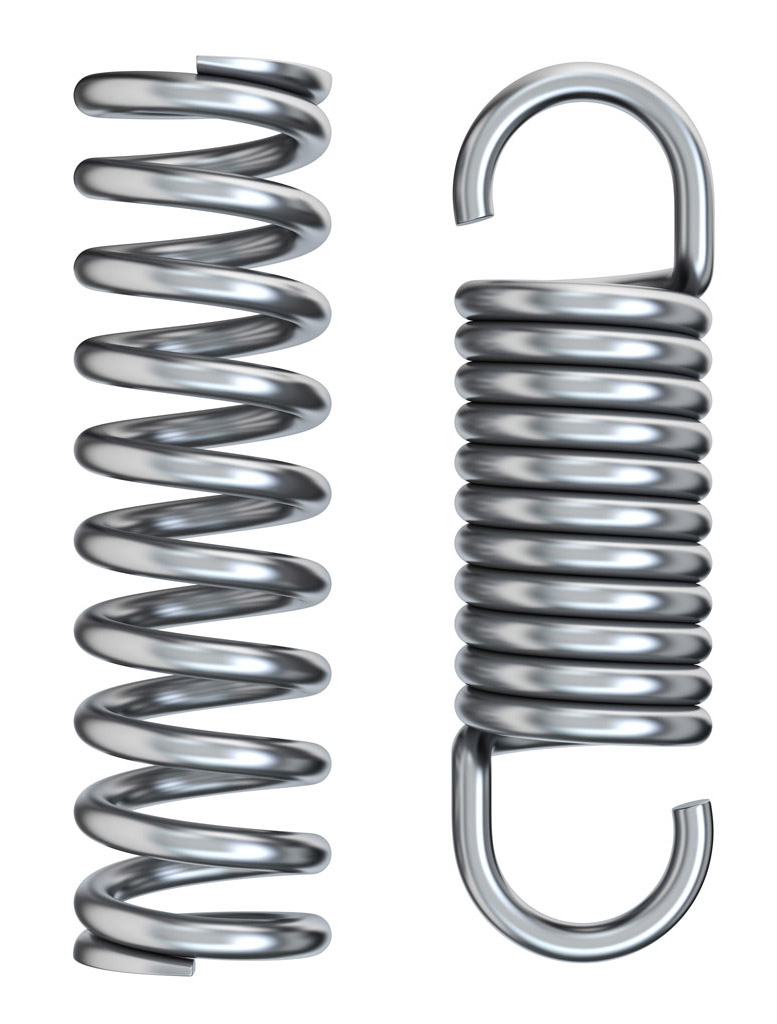
A compression spring is designed to resist a compressive force and return to its original length when that force is removed. Nearly every compression spring you encounter is a helical coil—wire wound into a cylindrical helix. The spring sits in its natural state, and when you push down on it, it compresses. Release the load, and it springs back.
Compression springs are everywhere. Automotive suspension systems rely on them. Valve assemblies use them to hold valves open or closed. Industrial machinery uses them in dampers and load distributors. Even pens and mechanical switches contain compression springs.
The geometry of a compression spring is straightforward: wire diameter, coil diameter, number of active coils, and the type of end condition (open ends, closed ends, or closed and ground ends). These parameters determine the spring rate—how much force is needed to compress it a given distance.
What makes compression springs reliable is that they naturally resist permanent deformation. The coils support each other, and the helical design distributes load relatively evenly across the wire. In static loading, they’re robust. Under cyclic loading, they behave predictably, which is why they’re the default choice for most industrial applications.
Extension Springs: Design and Mechanics
An extension spring (also called a tension spring) is the opposite. It’s designed to resist being pulled apart. Where a compression spring sits relaxed, an extension spring is under constant tension even in its natural state. The coils are tightly wound, often with an initial tension built in during manufacturing.
The most obvious difference you’ll see is the ends. Compression springs have coil ends (open or closed). Extension springs have hooks, loops, or eyes at each end—attachment points that allow the spring to be pulled. The end configuration is critical. A poorly designed or weak attachment point can cause premature failure, regardless of how good the wire is.
Extension springs are common in door closers, garage door mechanisms, hinges, upholstery systems, and measurement instruments. They’re also used in trampolines, jumping equipment, and any application where stored energy from extension is desirable.
The challenge with extension springs is that the ends carry stress concentration. The transition from the wire diameter to the hook or eye creates a geometric discontinuity. Fatigue cracks typically start here, not in the coil. This is why the design of the end attachment matters as much as the wire quality.
Mechanical Behavior: The Core Difference
Both compression and extension springs obey Hooke’s Law: the force exerted is proportional to the distance compressed or extended. But how they behave under various conditions differs.
Compression springs have a linear force-deflection curve when loaded axially. Load the spring, measure the deflection, and you get a predictable relationship. The spring constant (the slope of the force-deflection curve) remains consistent across the operating range.
Extension springs also follow Hooke’s Law, but with a twist: initial tension. Before you apply any external load, the coils are already under tension from the manufacturing process. This initial tension means that the first increment of pulling force goes into overcoming the coils’ resistance to separation. Only after you exceed the initial tension does the spring begin extending linearly. This makes the force-deflection curve non-linear in the very early stage of loading.
Why does initial tension matter? For applications requiring a specific force at zero deflection, initial tension is critical. For applications where you’re pulling a spring from its natural length, initial tension affects the starting point of the load-deflection relationship. Understanding this is essential when you’re testing extension springs and interpreting the results.
Relaxation and Permanent Set
Both spring types experience relaxation—a gradual loss of force over time, especially under continuous load or at elevated temperature. But the mechanisms differ slightly.
Compression springs, with their geometry and the way load is distributed across the coils, tend to relax more uniformly if they relax at all. Material quality and initial stress are the primary drivers. A high-quality compression spring made from properly heat-treated wire might show negligible relaxation after a million cycles. A lower-quality spring might lose 5-10% of its force.
Extension springs are more prone to relaxation because the stress concentration at the ends creates locally elevated stresses. Even if the coil material is excellent, weakness at the attachment point can initiate relaxation or crack growth. This is why extension spring reliability depends heavily on end design and manufacturing precision.
Permanent set is the amount by which a spring fails to return to its original length after being deflected. Most springs exhibit some permanent set, especially in the first few cycles. High permanent set indicates the material is yielding plastically, which is a problem. For extension springs, permanent set often starts at the ends before it appears in the coil itself.
Load Capacity and Failure Modes
Compression springs can handle higher loads per unit of material than extension springs, primarily because the load is distributed across the coil. A 20mm diameter compression spring might safely handle 5,000 N of force, while an extension spring of similar wire diameter is limited to perhaps 2,000-3,000 N because the end attachments create stress concentrations.
The failure modes differ too. Compression springs fail when fatigue cracks initiate at stress concentrations (usually at the coil ends) or when the wire yields under load. Failure is often catastrophic—the spring breaks suddenly.
Extension springs fail similarly, but earlier. Cracks typically initiate at the end attachment and propagate into the coil. If the end design is weak, failure can occur well before the coil material would predict. Many extension spring failures in the field are actually end attachment failures, not wire failures.
Testing Considerations
These mechanical differences have direct implications for how you test springs.
Compression springs are tested by pushing down (compression) in a vertical orientation. The test frame applies a controlled load, and you measure deflection and force. Static tests are straightforward. Fatigue tests involve cycling between a minimum and maximum load—compress, release, compress, release—thousands or millions of times.
Extension springs require pulling (tension) testing. The test fixture must grip the ends securely without damaging them. This is trickier than it sounds. If you’re not careful with the grip design, you can introduce local stress concentrations that invalidate the test. The fixture must distribute load evenly across the hooks or eyes.
For fatigue testing of extension springs, the concern is end attachment failure. You need to monitor not just force loss and deflection change, but also visual inspection for cracks at the ends. Some extension spring tests include pull-to-failure tests precisely to understand where the weak point is.
Temperature effects also differ. Compression springs at elevated temperature experience relaxation, but the change is relatively predictable. Extension springs at elevated temperature are more problematic because relaxation at the ends can accelerate stress concentration and crack initiation.
We reccommend checking out the full line of testing equipment from SAS Testers.
Choosing Between Compression and Extension
For design and specification, the choice usually comes down to space and function. If you need a spring that resists compression and you have axial space, compression is simpler and more reliable. If you need stored energy from extension or you’re building a system with specific attachment requirements, extension might be necessary.
For testing, the choice determines your fixture design and test interpretation. Compression springs are more forgiving to test. Extension springs require more sophistication in the fixture and more caution in interpreting results. An extension spring test isn’t just measuring how hard it pulls—it’s also assessing whether the ends will hold up under the loading.
If you’re designing a new product that uses springs, specify both types based on functional requirements, not cost alone. A cheaper extension spring with weak end attachments will fail faster and cost more to debug and replace than a more expensive spring with proper end design.
Material and Manufacturing Context
Both spring types are made from similar materials—alloy steel, stainless steel, or specialty wire—but the manufacturing processes differ slightly.
Compression springs are coiled around a mandrel and then stress-relieved. The open coils (if they’re open-ended) don’t require secondary operations beyond cutting the wire.
Extension springs are more complex. After coiling, the ends must be formed—bent into hooks, loops, or eyes. This bending creates additional stress and potential weak points. The spring is then stress-relieved. Quality control is more critical because a poorly formed end can compromise the entire spring.
This manufacturing difference is why extension springs cost more than compression springs of similar wire diameter, and why you see performance variability more often in extension springs. The end-forming process introduces variables that don’t exist in compression spring manufacturing.
Real-World Reliability
In field applications, compression springs typically outlast extension springs by a significant margin when subjected to the same cycle count and load magnitude. This isn’t because the material is better; it’s because the geometry is more forgiving.
Extension springs fail more often, earlier, and more unpredictably. But they’re also necessary for many applications. Understanding their limitations—the stress concentration at the ends, the sensitivity to relaxation, the importance of end design—helps you select springs that will actually last and design testing protocols that catch problems before they reach the field.